Most “best open source DBMS” guides are solving the wrong problem. They compare query speed, extensions, and benchmark charts as if a 20–200 person company is choosing infrastructure for a hyperscale platform. In practice, the database rarely determines whether your company can trust revenue, retention, pipeline, or product usage numbers.
Your real constraint is usually simpler. One or two generalist engineers are keeping application systems alive while the CFO waits days for a revenue refresh, and every dashboard has a slightly different definition of “active customer.” A startup can spend weeks debating PostgreSQL versus MySQL while analysts still export CSVs and reconcile totals by hand.
The right question is not “Which engine wins?” It's which database will remain supported, affordable, hireable, and boring while your company builds a reliable reporting system around it?
Table of Contents
- Why the Database Is Rarely Your Real Problem
- What Open Source Databases Do in 2026, by Workload
- Postgres, MySQL, ClickHouse, DuckDB and Friends
- The Cost and Hiring Implications You Feel
- Licensing Forks and Continuity Risk
- Choosing by Stage Not by Feature List
- From Database Choice to Metrics You Can Trust
Why the Database Is Rarely Your Real Problem
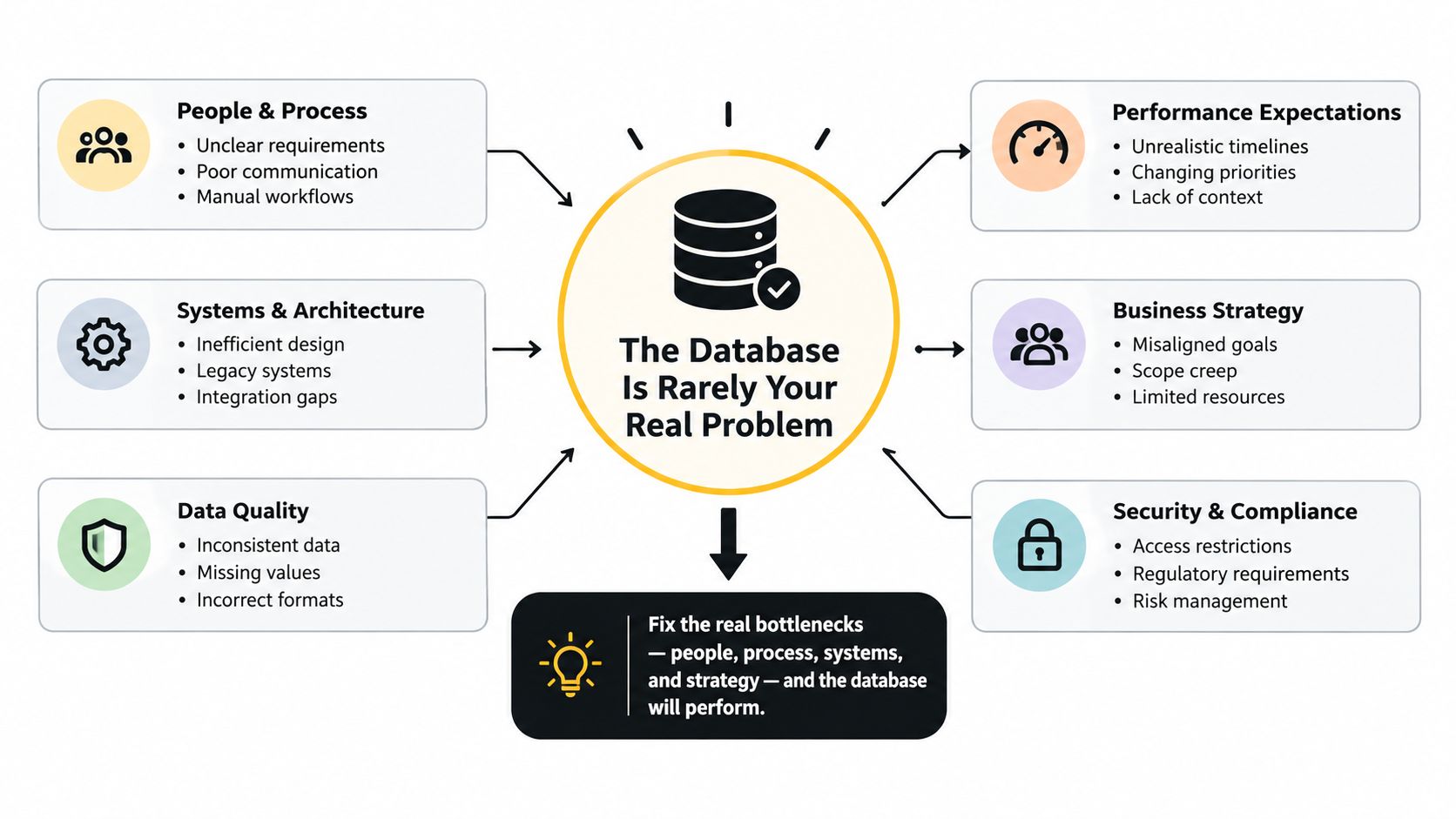
The database is rarely the constraint. Reporting trust is.
A 20–200 person company usually does not have a throughput crisis. It has conflicting definitions, unclear ownership, and numbers that change depending on who runs the report. Product events use inconsistent names. Finance reports booked revenue while RevOps reports recognized revenue. Marketing counts leads differently from the CRM. A fast query can still produce an answer nobody will defend in a board meeting.
That makes database choice a continuity decision, not a benchmark contest. Both PostgreSQL and MySQL have supported mainstream production applications for over two decades, so either is a defensible operational default. The industry coverage of the open-source database market also treats both as established choices. Pick the system your team can operate, hire for, and keep stable while reporting work catches up.
The bottleneck sits upstream
A Series A company can spend six weeks comparing Postgres and MySQL, then keep producing board metrics in spreadsheets. The database is running. The operating model is not. Someone must own metric definitions, lineage, freshness, and reconciliation.
Operator rule: Don't migrate a database to solve a metrics governance problem.
The business needs agreed definitions before it needs a faster engine. It also needs named data owners, freshness expectations, and a clear method for detecting metric drift. HelpWithMetrics explains what data reliability means, including the difference between data being available and reporting being dependable.
For most startups, the database decision was made when the product was built. Reopen it only for a measured operational reason, such as reliability, supportability, or a workload the current system cannot handle. Otherwise, migration creates retraining, new failure modes, and hiring costs without fixing the reporting problem leadership is escalating.
The decision is whether the company will staff data ownership at all. An ordinary database with accountable operators beats a technically impressive engine attached to numbers nobody trusts.
What Open Source Databases Do in 2026, by Workload
Choose by workload, not by popularity. An operational database, analytical engine, notebook database, and search system may all be called databases, but each solves a different job. For a 20 to 200 person company, the harder decision is whether the added engine improves continuity and reporting trust enough to justify another system to hire for and operate.
| Workload Bucket | Representative Engines | Typical Startup Use |
|---|---|---|
| Operational OLTP | PostgreSQL, MySQL, MariaDB, CockroachDB | Application records, orders, accounts, billing |
| Analytical columnar | ClickHouse, DuckDB, StarRocks, Doris | Event analysis, product analytics, large aggregations |
| Embedded analytics | DuckDB, SQLite | Analyst notebooks, local extracts, embedded reporting |
| Search and vector | OpenSearch, Meilisearch, pgvector | Text search, recommendations, retrieval systems |
| Time-series | TimescaleDB, InfluxDB, VictoriaMetrics | Infrastructure metrics, sensor data, time-indexed events |
Start with the workload
Operational OLTP is the default starting point. PostgreSQL gives teams a broad relational foundation. MySQL offers mature hosting options and a large hiring pool. MariaDB provides a familiar MySQL-oriented path, while CockroachDB fits companies that require globally distributed writes for operational reasons.
Analytical columnar systems earn their place when queries repeatedly scan and aggregate large event histories. ClickHouse targets this workload, while StarRocks and Doris offer different trade-offs around joins, concurrency, and operating complexity. The test is simple: whether your product or reporting workload needs a separate analytical path. If it does, isolate that workload deliberately. If it does not, another engine adds hiring and continuity risk without solving a business problem.
DuckDB and SQLite work well because they are embedded and easy to move. Use them for local analysis, notebook workflows, testing, and smaller reporting artifacts where a separate service would add more operational weight than value.
Search and time-series systems belong in the stack only when their data models match the workload. OpenSearch or Meilisearch can support search-heavy products. pgvector can extend PostgreSQL for vector retrieval. TimescaleDB or VictoriaMetrics can handle time-indexed workloads. Do not add any of them because a feature list makes the option look modern.
The 2026 decision is rarely which first database wins a benchmark. It is whether the company will fund another operational responsibility, with named ownership, hiring coverage, and reporting controls. In many cases, one well-run engine protects business continuity better than a fragmented stack.
Postgres, MySQL, ClickHouse, DuckDB and Friends
For a 20–200 person company, the database rarely determines performance. Ownership, hiring coverage, and reporting trust do. PostgreSQL is my default for a new B2B SaaS because it handles transactional application data, supports a broad extension ecosystem, and lets a small team keep one operational system for longer. A few hundred gigabytes with sustained concurrent writes can remain in Postgres when the schema, queries, and workload boundaries are managed competently.
MySQL earns the recommendation for read-heavy consumer applications, marketplaces, and commerce platforms that value mature hosting options and a large hiring pool. Its long history matters operationally. Oracle's continued release cadence through MySQL 8.x keeps it a supported, hireable default.
| Engine | Earns Its Keep When | Wrong Fit When |
|---|---|---|
| PostgreSQL | You need a capable default for a B2B SaaS and want one operational system to carry application complexity | Your workload is dominated by massive event scans that should be isolated from transactions |
| MySQL | You're running a read-heavy marketplace or consumer application with established hosting and hiring options | Your team depends on PostgreSQL-specific extensions or ecosystem conventions |
| MariaDB | You need a familiar MySQL-oriented path with openness to a related implementation | You're treating it as a risk-free substitute without reviewing compatibility and vendor direction |
| ClickHouse | Product analytics or observability requires repeated analytical scans over large event histories | Your main workload is frequent single-record updates and transactional integrity |
| DuckDB | Analysts need local notebooks, extracts, or embedded reporting without another always-on service | Many users need a shared, governed, highly concurrent production warehouse |
| CockroachDB | Global writes and distributed availability are hard business requirements | Geographic distribution is only a theoretical future concern |
ClickHouse is the specialist choice for product analytics. A SaaS that needs fast cohort exploration across a large event stream can separate analytical demand from its transactional system. Adopt it when query patterns create sustained pressure, not because a benchmark looks impressive. The business case must cover ownership, data definitions, and recovery procedures.
DuckDB suits analysts who need local notebooks, extracts, or embedded reporting. It keeps analytical work close to the analyst without requiring another always-on service. It is not a shared governance layer for many concurrent users, so establish how approved results reach company reporting.
MariaDB fits teams already invested in MySQL conventions, provided they review compatibility and vendor direction first. CockroachDB belongs in environments where global writes and distributed availability are required. Each specialized engine adds another hiring profile, deployment path, and failure mode. That burden needs a business reason.
Start with the workload before changing engines. Teams often blame the database for inefficient queries, weak indexing, or uncontrolled dashboard traffic. Guidance on how to optimize queries and scale databases is more useful than another generic benchmark table when those are the constraints.
The practical recommendation is simple: choose the engine your team can staff, operate, and explain to finance. A trusted report on one well-run system beats a fragmented stack that nobody can maintain or reconcile.
The Cost and Hiring Implications You Feel
The database invoice is rarely the main cost. People and controls keep replicas, backups, alerts, permissions, and recovery dependable. For a 20–200 person company, the decision is whether to staff data operations at all.
Our 2026 planning model puts managed PostgreSQL or MySQL at $1,200–$4,500 per month for a 5–8 TB cluster, depending on high-availability topology. It places ClickHouse Cloud and Snowflake-managed equivalents at $3,000–$15,000 once workloads exceed three billion rows. These are internal budgeting ranges, not vendor quotes. Use this guide to how much data costs to include reconciliation, dashboard maintenance, and reporting labor in the same calculation.
| Database | Managed monthly cost, mid-scale | Specialist base salary, US | Hiring difficulty |
|---|---|---|---|
| PostgreSQL | $1,200–$4,500 | $135K–$165K | Moderate |
| MySQL | $1,200–$4,500 | $115K–$145K | Lower |
| ClickHouse | $3,000–$15,000 | $165K–$210K | High |
| DuckDB | Usually embedded or workload-dependent | $115K–$145K for a generalist comfortable across MySQL and DuckDB | Moderate |
| MariaDB | Workload and provider dependent | MySQL-adjacent generalist market | Moderate |
| CockroachDB | Workload and topology dependent | Specialist market | High |
The hiring ranges expose the operating trade-off. A mid-level PostgreSQL DBA is budgeted at $135K–$165K base, a ClickHouse specialist at $165K–$210K, and a generalist data engineer comfortable across MySQL and DuckDB at $115K–$145K. The difference covers recruiting time, onboarding risk, coverage gaps, and the difficulty of assigning ownership when the team is small.
Coverage is the hidden cost
A niche system can make one employee the only person who understands partitioning, replication, backups, and query conventions. That creates a continuity risk even when performance is excellent. Sick leave, turnover, or a failed deployment then becomes a reporting problem.
Practical rule: Pick the database your current engineers can carry before choosing the database a future specialist might optimize.
A first data hire also needs a clearly defined remit. Teams evaluating the role can browse DBA positions in data science to see how reliability, access management, performance, and recovery fit together.
The financial comparison is managed, boring infrastructure versus another full-time responsibility. For a smaller company, PostgreSQL or MySQL usually wins when it keeps reporting trustworthy without creating a specialist dependency. Choose a more specialized engine only when its workload advantage pays for the added hiring and coverage burden.
Licensing Forks and Continuity Risk
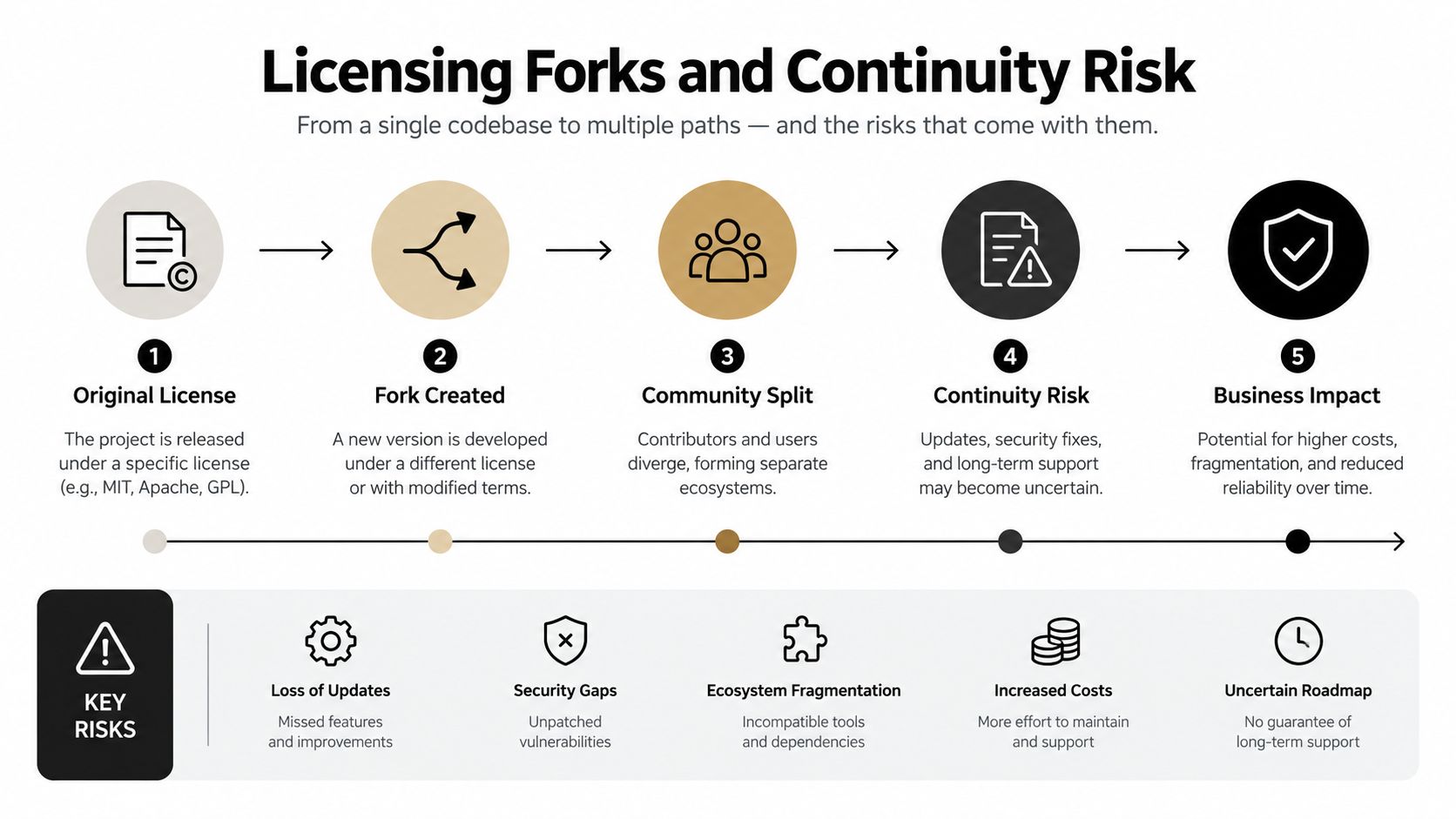
License names matter, but they aren't the continuity plan. PostgreSQL uses the PostgreSQL License, MySQL uses the GPL with a FOSS exception, and ClickHouse and DuckDB use Apache 2.0. Those licenses describe rights and obligations. They don't guarantee that the vendor you rely on will keep the same commercial strategy, managed service, or product direction.
The risk appears when an infrastructure company changes course. MongoDB's SSPL shift and Elastic's move to AGPL triggered long migration discussions, but the broader operator lesson is more important than either event: a popular database can still become an awkward business dependency.
Redis is the current reminder. The supplied market analysis says Redis's licensing changes increased interest in alternatives and forks such as Valkey, while MySQL, MariaDB, Redis, and PostgreSQL remain among the most widely adopted open-source database systems at roughly 44%–52% usage each in the referenced 2026 usage data, as reported by OpenLogic's database analysis. Popularity protects hiring and community support. It doesn't remove continuity risk.
Judge the exit, not just the entry
For a small company, the right questions are practical:
- Who controls the project? An independent foundation or broad community generally gives you more resilience than a single commercial owner.
- Can you move providers? At least two credible managed vendors should be able to support the engine.
- Does a production fork exist? A serious fork gives the market an alternative if licensing or product direction changes.
- Can your team operate it? Documentation and hiring depth matter more than an impressive feature roadmap.
The goal isn't to predict every vendor move. It's to avoid a database that becomes irreplaceable before the company has the people or budget to manage that exposure.
A continuity review should therefore happen before adoption, not during an emergency migration. For a 20–200 person company, a slightly less specialized engine with multiple support paths is often the stronger business decision than a faster engine controlled by a narrow vendor ecosystem.
Choosing by Stage Not by Feature List
Throw out the comparison matrix. Company stage tells you more than a feature checklist because team shape determines how much operational complexity the business can absorb.
Use a stage-based rubric
- Pre-seed and seed, under 10 people: Choose managed PostgreSQL or MySQL. Keep engineering focused on the product and avoid turning the data layer into a second product.
- Growth, 10–50 people: Keep the operational database boring. Add a read replica or separate reporting path only when reporting pressure is measurable and recurring.
- Scale, 50–200 people: Introduce ClickHouse, DuckDB, or another specialized engine only when a measured workload justifies the additional ownership. Don't add a second transactional engine because a benchmark says you might need one later.
A company in the middle stage usually doesn't need another transactional database. It needs cleaner definitions, stable reporting ownership, and a reliable way to answer leadership questions without rebuilding every chart.
That's also the point where a broader technology brokerage framework can help operators evaluate technology decisions against business requirements instead of vendor feature lists. Keep the same discipline when choosing BI tools for startups. The tool should reduce reporting work, not create another system for engineers to maintain.
Decision test: If revenue hasn't forced the bottleneck, don't pay for the complexity.
From Database Choice to Metrics You Can Trust
A database stores facts. It doesn't decide what “net revenue retention” means, whether refunds belong in the numerator, or which source owns customer status. It also can't tell the CFO that a dashboard is stale because a pipeline failed upstream.
Metrics trust comes from definition discipline, lineage, and observable freshness. The database is one layer in that system, but it isn't the layer that resolves conflicting business logic. Two teams can run the same query against the same database and still disagree because they're asking different questions under the same label.
That's why agentic BI matters more here than choosing Postgres over MySQL. A plain-English question is only useful when the underlying metric has an owned definition and the resulting chart can be traced back to its source. HelpWithMetrics works with customer-owned data sources and database environments, including open-source setups, so the database decision doesn't need to become a migration project before reporting improves.
The practical outcome is a working dashboard built against the company's actual data, with disagreements exposed instead of hidden in spreadsheet tabs. The next quarter should be spent on a system that flags definition drift and makes reporting explainable, not on a migration that buys a few milliseconds without fixing trust.
The database was never the bottleneck. The bottleneck was the absence of a dependable system for deciding which number is correct.
HelpWithMetrics builds done-for-you dashboards and an agentic BI layer for companies with 20–200 employees that need reliable metrics without immediately hiring a full data team. Visit HelpWithMetrics to book a working session and get a free first dashboard built from your real data.