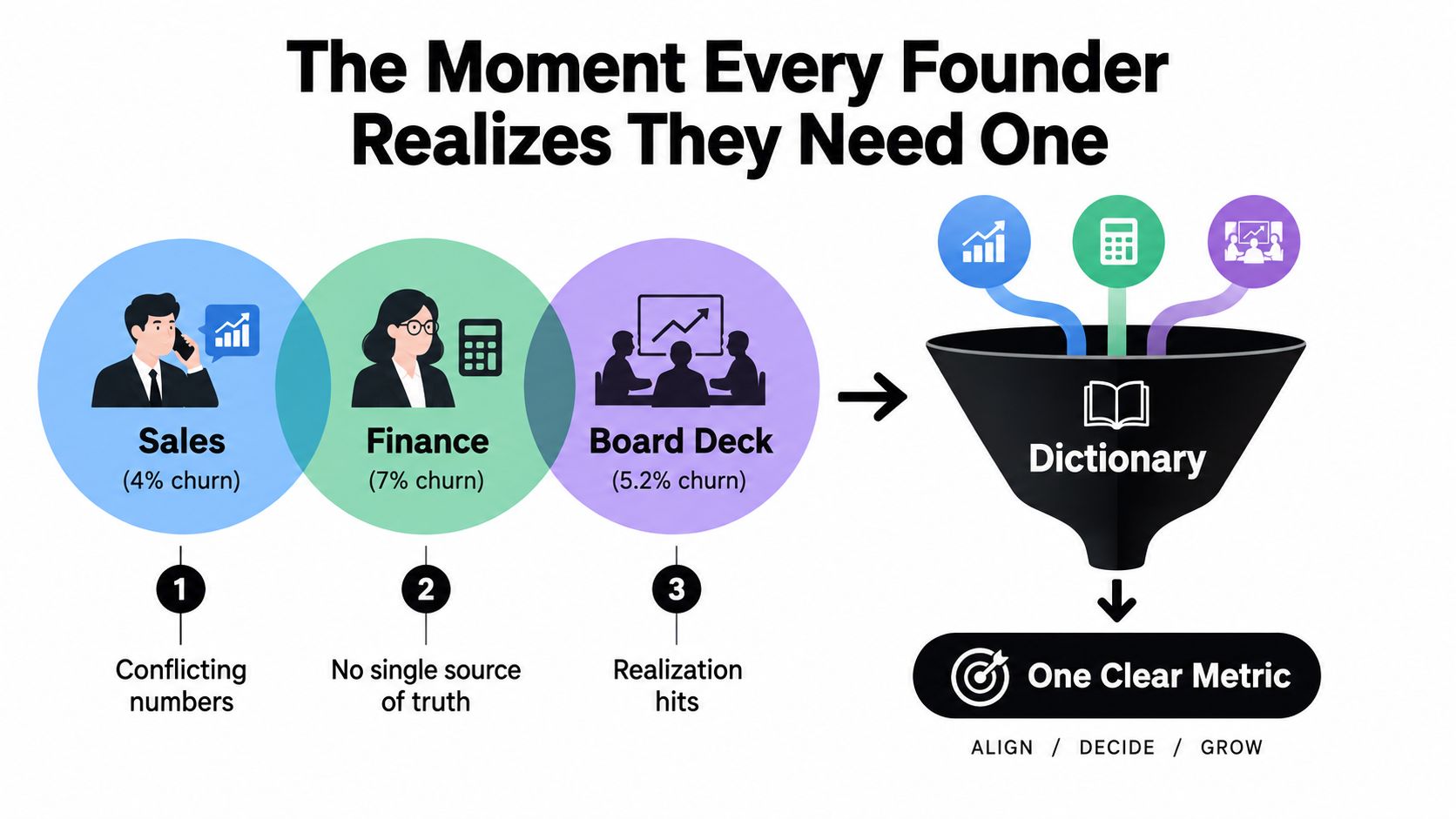
A board meeting turns tense when the CEO asks one simple question: “What's our churn?” Sales opens its CRM. Finance opens the billing system. RevOps pulls a dashboard. Everyone has a number, and everyone can explain why theirs is correct.
Nobody is necessarily lying. The company has allowed different tools and teams to assign different meanings to the same word. A search for a database for dictionary usually starts as a technical question, but the operational problem is more serious. You don't need another place to store definitions. You need one agreed meaning, a named owner, and a system that can apply that meaning consistently to reports, dashboards, and AI answers.
Table of Contents
- The Moment Every Founder Realizes They Need One
- What People Actually Mean by a Dictionary
- Storage Options and Why Three of Them Break
- Why the Database Is Almost Never the Bottleneck
- What Governance Actually Looks Like in Practice
- The Build vs Buy Decision for a 20 to 200 Person Team
- What to Verify This Week Before Centralizing Definitions
The Moment Every Founder Realizes They Need One
Recognition often arrives during a QBR. The sales leader says churn is under control. Finance says the number is materially higher. The board deck shows a figure that sits between them, carefully formatted and impossible to reconcile before the meeting ends.
The disagreement usually comes from reasonable choices. Sales may count accounts that cancel. Finance may count recurring revenue lost during the period. The board may be looking at a cohort calculation that excludes certain customers or uses a different date rule. Each team has built a calculation that works for its immediate purpose, but the business has no shared definition that governs all three.
That is the moment a founder starts searching for a database for dictionary. The search sounds like a request for software, storage, or a schema. The underlying request is simpler and more consequential: “Where is the definition of this metric, who approved it, and how do I know every report uses the same one?”
The missing decision
A shared definition needs an accountable person. Without that person, a glossary becomes a suggestion, a spreadsheet becomes an archive, and a dashboard becomes another opinion.
Start with the metric that causes the most executive friction. Ask four questions:
- What does it include? State the customers, events, revenue types, or dates covered.
- What does it exclude? Document trials, pauses, credits, refunds, test accounts, and other edge cases.
- Who owns the definition? Give one person authority to approve changes.
- Where must it appear? Identify the dashboards, board reports, alerts, and AI interfaces that depend on it.
The historical model for a data dictionary came from databases themselves. Oracle's database documentation describes the database data dictionary as a central, read-only reference set containing definitions for schema objects, users, privileges, roles, and auditing information. That's a useful distinction. A dictionary isn't merely a page where someone writes down terminology. It can be part of the control plane that determines what exists and how systems interpret it.
The founder's real question isn't “Which database should hold our dictionary?” It's “Who owns the truth, and can every system use it?”
What People Actually Mean by a Dictionary
The word dictionary hides several different products. Choosing the wrong one creates the appearance of order without fixing conflicting metrics.
A glossary is for people
A glossary is the human-readable menu of business language. It tells a new employee what the company means by “qualified lead,” “active customer,” or “expansion.” It's useful for onboarding, cross-functional communication, and reducing avoidable terminology disputes.
A glossary usually stops at explanation. It may say what a term means, but it doesn't necessarily identify the underlying fields, calculation logic, filters, owner, or downstream reports affected by a change.
A data dictionary is for structure
A data dictionary describes technical metadata. It connects a field to its name, type, description, source, and sometimes permitted values or transformation rules. The USGS overview of data dictionaries describes this kind of resource as metadata for data elements and notes that many database management systems have built-in dictionaries.
Think of it as the kitchen inventory. It tells you which ingredients exist and where they are stored. It doesn't automatically tell the chef which recipe the company has approved for net revenue retention.
A business dictionary is for decisions
A business dictionary records the agreed rules behind a metric. It should answer questions such as whether a downgraded contract counts as churn, whether a paused subscription remains active, and which date controls the reporting period.
This is the recipe. It turns raw ingredients into a repeatable result. The business dictionary matters most when executives care about a number across departments, because it records the judgment behind the calculation rather than only the field names.
A semantic layer is for machines
A semantic layer connects governed business meaning to the underlying data. It allows a person to ask a plain-English question and gives an analytics system the context needed to select the right fields, filters, joins, and metric logic.
The analogy is a waiter who knows the menu, the kitchen, and the customer's question. A glossary can explain “NRR.” A data dictionary can identify the columns. A business dictionary can document the formula. The semantic layer is what allows a system to retrieve the right answer consistently when someone asks for NRR by segment.
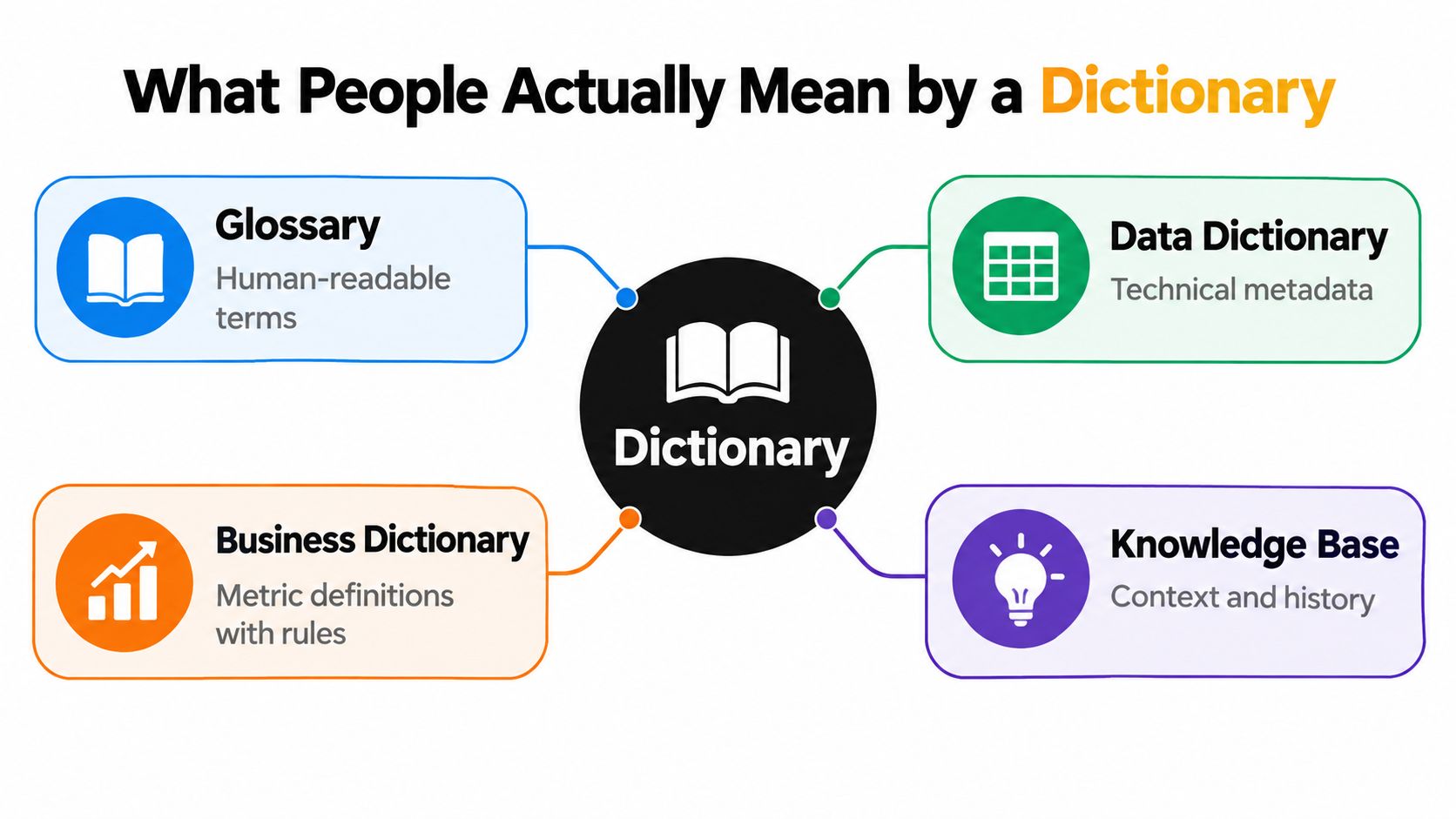
A knowledge base adds context and history. It can preserve why a definition changed, which decision approved it, and how teams used the term before the current standard. That context helps people, but it doesn't replace executable metric logic.
If your problem is a confusing field name, start with a data dictionary. If your problem is employees using inconsistent language, create a glossary. If executives receive conflicting KPIs, you need a governed business dictionary connected to a semantic layer. Calling all four things a “dictionary” is how teams buy the wrong solution.
Storage Options and Why Three of Them Break
The storage decision matters less than the operating model, but the container still affects how much work your team must do. Founders usually consider four paths.
| Approach | Best for | Where it breaks |
|---|---|---|
| Shared spreadsheet | Early documentation and visible ownership | People edit definitions without a reliable approval process, and downstream tools don't inherit changes |
| DBMS data dictionary | Technical metadata inside one database | It describes database objects, not the shared business meaning of metrics across systems |
| SaaS glossary tool | Human-readable terminology and onboarding | Definitions remain difficult for dashboards, query tools, and AI systems to interpret consistently |
| Semantic layer | Governed metrics used across analytics and AI | Requires clear ownership and disciplined maintenance, not just a purchase |
The spreadsheet
A shared Google Sheet feels perfect at the beginning. It is familiar, cheap, and easy to send to a colleague. The first version often captures metric names, definitions, owners, and links to reports.
Then someone changes a formula in a dashboard without updating the sheet. Another person adds a second row for the same metric because the original definition doesn't fit a new use case. The document becomes a record of disagreements rather than a mechanism for preventing them.
The DBMS dictionary
A built-in database dictionary is valuable, especially for understanding tables, columns, privileges, and structural metadata. Oracle's long-standing documentation makes clear that this type of dictionary belongs to the database's own governance machinery, but that doesn't make it a cross-company metric registry.
If your churn definition depends on billing events, CRM account status, product activity, and contract dates, no single operational database dictionary can represent the full business rule by itself. It can tell you that the fields exist. It can't decide which interpretation the board should use.
Your warehouse architecture also affects where data can be reconciled. This comparison of data warehouse, data lake, and data mart responsibilities is useful context, but the metric definition still needs to sit above those storage choices.
The glossary platform
A SaaS glossary is a better home for human communication. It can improve discoverability and give teams a shared vocabulary. Its weakness appears when a user asks an AI system a question and expects a governed calculation rather than a paragraph of explanation.
A glossary entry saying “active customer means a customer with an ongoing relationship” is not enough. The machine needs to know which source fields establish that relationship, how dates are handled, and what to do with exceptions.
Teams building AI systems should also distinguish a dictionary of business definitions from the broader retrieval and context architecture described in an RAG architecture development guide. Retrieval can surface relevant information, but relevance alone doesn't guarantee that a metric is calculated according to the approved rule.
The semantic layer
A semantic layer is the only option in this list designed to carry meaning into multiple analytical experiences. It can connect governed definitions to dashboards, reports, and natural-language questions.
That doesn't make it magic. Without an owner, it becomes another technical asset with stale logic. With ownership, change control, and clear business rules, it becomes the operational contract between raw data and executive decisions.
Why the Database Is Almost Never the Bottleneck
A founder asks why sales reports show different counts for “active customer.” Engineering points to Postgres. Finance points to Snowflake. RevOps opens a spreadsheet. The disagreement survives every migration because the storage system was never the source of the problem.
The definition can live in Postgres, Snowflake, Databricks, Notion, or a document. The failure starts when no person has authority to decide what the term means across functions, record the decision, and keep every downstream use aligned.
A large healthcare survey shows how persistent this problem is. Only 32.8% of 7,828 respondents reported adopting a data dictionary, according to the published healthcare survey. Adoption varied by operating context, including 28% versus 20% across the reported population-density categories and 34.0% versus 30% across the reported HMO-enrollment categories.
Healthcare had serious reporting demands, yet shared definitions remained difficult to establish. A different database would not resolve that failure. The organization needed a decision owner, maintenance responsibility, and a reason for each team to use the approved meaning.

Ownership beats location
Ask who can approve a change to “monthly recurring revenue.” “Finance, probably” means the metric has no accountable owner. If sales, product, finance, and RevOps can each change their own version, the company has distributed interpretation, not a dictionary.
Operational test: If a metric changes tomorrow, can you identify one person who must approve the change and every report that must be checked afterward?
Choose storage based on access, integration, and operating cost. Teams comparing open-source database management systems should keep that choice separate from definition ownership. Advice on optimizing database performance can improve latency, indexing, query design, or resource use. Faster queries still produce the wrong answer when the metric is ambiguous.
AI raises the standard. A language interface can turn incomplete or conflicting context into a fluent, authoritative-sounding response. It becomes dependable for reporting only when it can retrieve definitions that are explicit, current, and machine-readable.
The right question is not “database for dictionary.” It is whether the business has an owned, governed semantic layer that machines can use. Storage is implementation. Meaning is the product.
What Governance Actually Looks Like in Practice
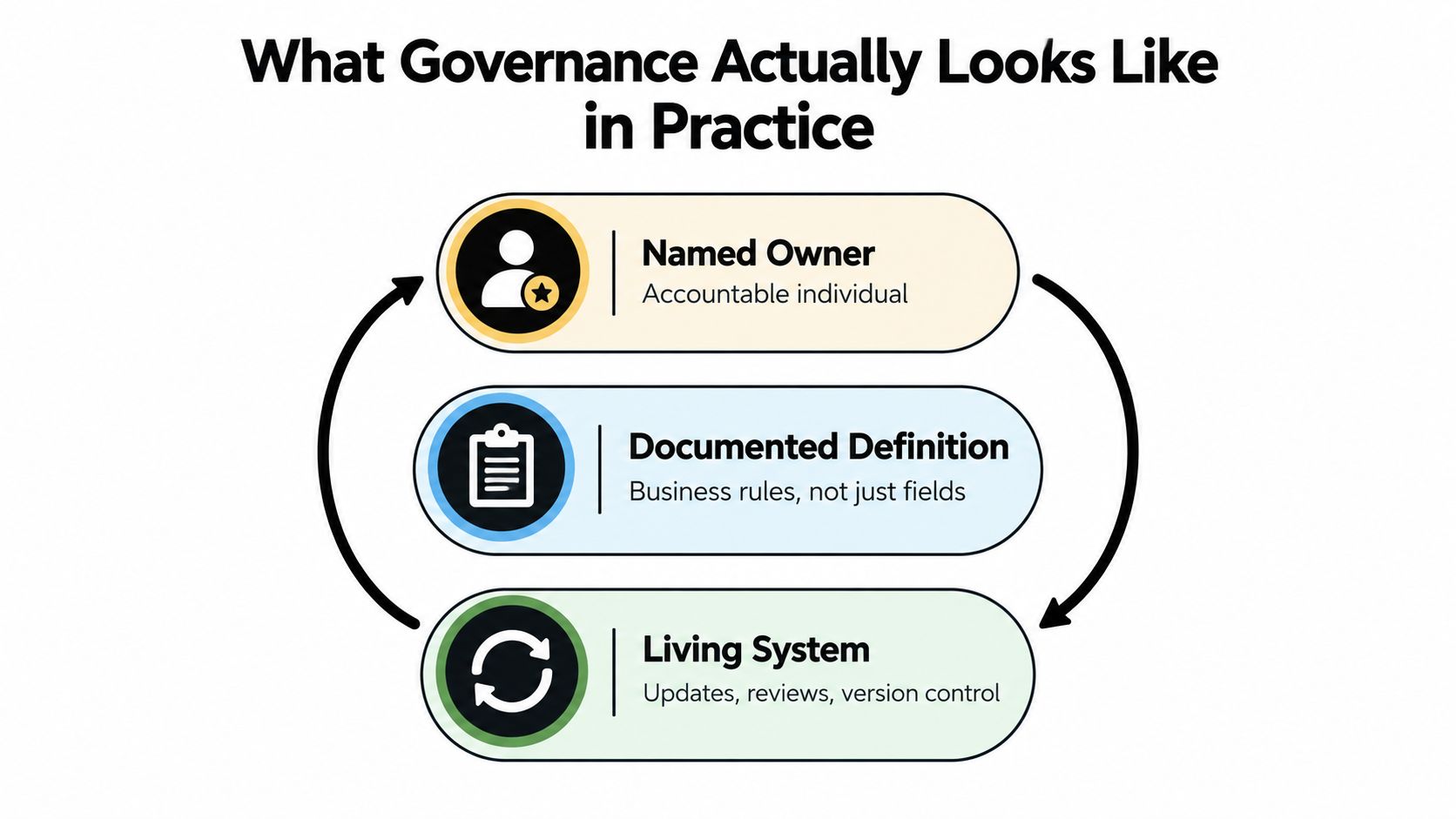
Practical governance has three parts, and removing any one of them creates a gap.
First, every important metric needs a named owner. This person isn't necessarily the person who writes SQL or builds dashboards. The owner is accountable for the business interpretation, including edge cases and approval of changes.
Second, the team needs a documented definition that contains business rules. “Revenue from active subscriptions” is a label, not a usable definition. The document must establish what counts as active, which revenue is included, how cancellations are dated, and how unusual records are treated.
Third, the definition must live in a living system. A static document can inform a person, but it can't reliably propagate a change to every dashboard, board report, alert, and AI query. The system needs version control, review discipline, and a way to connect the definition to the data products that use it.
The output is trust, not paperwork
A governed metric should answer more than “what is the number?” It should also answer:
- Why is this the number? The calculation rules and source data are visible.
- Who can change it? One accountable owner controls interpretation.
- What changed? The system preserves the relevant history.
- Where is it used? Reports and dashboards can be traced back to the definition.
- Can AI use it? The meaning is structured well enough for a machine to apply it.
That last question separates documentation from agentic BI. A founder should be able to ask for net revenue retention by segment in plain English and receive a chart based on the same governed definition used in the board report. The system doesn't earn trust because it sounds confident. It earns trust because the answer is tied to an approved semantic model.
A useful operating model needs explicit responsibilities across business and data teams. The data governance operating model provides a helpful reference for thinking about those responsibilities without reducing governance to a document repository.
A living system has consequences
When an owner changes a definition, someone must assess the effect on historical reporting. A change to the meaning of “customer” can alter dashboards, compensation logic, investor reporting, and AI-generated analysis. Governance makes those consequences visible before the new rule spreads unnoticed.
The result isn't bureaucratic perfection. It is a shorter path from a plain-English question to a defensible answer. That is what founders want from a database for dictionary.
The Build vs Buy Decision for a 20 to 200 Person Team
A company in this range usually has enough data complexity to need governance and not enough spare capacity to build a durable system casually. The first data hire is often expected to repair pipelines, define metrics, build dashboards, answer ad hoc questions, and support finance at the same time.
That mandate is too broad for one person. The hire may be capable, but the company is asking for a data platform, a reporting function, and a governance program before it has agreed on priorities. The result is often a long period of partial delivery, with dashboards appearing before the definitions underneath them are settled.
The hidden cost of building internally
A full-time analyst or analytics engineer brings important capabilities, but hiring doesn't eliminate the work around the role. Leaders still need to define scope, provide access, resolve cross-functional disagreements, review models, and decide who owns the resulting system.
The risk isn't only salary. It is time-to-trust. If the company spends months debating tools while executives continue using conflicting reports, the business is paying for uncertainty even when the hiring plan looks reasonable.
Building internally makes sense when data work is central to the product, the company has a strong technical leader available to sponsor it, and metric ownership already exists across departments. It is a poor first move when the immediate need is a reliable operating picture.
What a managed option should deliver
A done-for-you service should be judged by outcomes, not the number of dashboards delivered. It should connect to customer-owned databases or cloud warehouses, establish shared definitions, expose metric logic to analytics tools, and make the resulting data usable through plain-English questions.
The service also needs a clear boundary. It shouldn't become a permanent substitute for executive decisions about what the business measures. The company still owns the meaning of its metrics. A good partner makes that ownership explicit and turns it into a maintained system.
For teams evaluating outside support, compare the options on:
- Speed to a trusted answer, not speed to a visual dashboard.
- Ownership of definitions, not ownership of a vendor workspace.
- Coverage across tools, not performance in one reporting interface.
- Maintenance responsibility, not just initial implementation.
- AI readiness, meaning whether a machine can use the same governed rules as a human analyst.
The best decision is the one that closes the reporting trust gap without creating another unowned system.
What to Verify This Week Before Centralizing Definitions
Don't begin by selecting a database. Begin with the questions your board and leadership team already ask.
Choose five metrics that repeatedly create disagreement. Include measures from different functions, such as revenue, retention, pipeline, activation, or customer health. For each one, collect the current definition from every team that reports it. The differences will tell you more than a software demo.
Make the disagreement visible
Write the definitions side by side. Don't normalize the language yet. Preserve the exact wording people use, because vague phrases often hide the core conflict.
Then identify the source of each answer and ask:
- Which events are included? Look for differences in cancellations, upgrades, refunds, credits, trials, and reactivations.
- Which date controls the result? Teams often disagree because one uses an invoice date while another uses an event date.
- Which records are excluded? Test accounts, internal users, duplicate organizations, and incomplete records can change the outcome.
- Who approves the definition? If no person accepts responsibility, the metric isn't governed.
- How long does reconciliation take? Time the process from the question to an answer everyone accepts.
Don't rush to eliminate every difference. Some teams may need different views for legitimate operating reasons. The problem is pretending those views are the same metric.
Test machine readability
Give the current documentation to someone who wasn't involved in creating it, or to an AI system operating against the approved context. Ask for the metric in a specific slice, such as by segment or reporting period. If the answer requires a personal explanation from the person who built the spreadsheet, the definition isn't ready for reliable automation.
Teams building an AI knowledge base can also review these AI-driven knowledge base tips, especially around keeping context findable and usable. But retrieval is only part of the problem. The content must still contain decisions, ownership, and rules rather than disconnected descriptions.
The decision this week is not whether to buy a warehouse. It is whether the company will keep treating metric definitions as informal tribal knowledge. Once the gap is visible, choose the smallest governed system that can connect the approved meanings to the reports and questions that matter.
HelpWithMetrics connects your existing data sources to a managed semantic layer so your teams can work from shared metric definitions instead of competing spreadsheets. Book a call with HelpWithMetrics to request a free first dashboard and see what a trustworthy answer looks like in your own data before committing to an internal build.