Training effectiveness measurement is often presented as a survey problem. It isn't. A satisfaction form can tell you whether people enjoyed a session, but it can't tell you whether they changed how they work, whether that change improved performance, or whether the improvement came from training at all. Treating positive feedback as proof of value is one of the most persistent measurement errors in learning and development.
Business leaders don't fund training to collect favorable comments. They fund it to improve execution, reduce risk, increase productivity, strengthen customer outcomes, or support strategic change. The measurement system has to follow that chain, even when the evidence is inconvenient. If the data shows that a well-liked program isn't changing behavior, the right response isn't to defend the program. It's to fix it, redesign it, or stop funding it.
Table of Contents
- Why Most Training Programs Fail to Prove Their Value
- Understanding the Kirkpatrick Model and Its Limits
- The Four Core KPIs That Matter for Business Outcomes
- Estimating ROI and the Hidden Costs of Measurement
- Solving the Attribution Problem in Training Evaluation
- Building Your Training Measurement System
Why Most Training Programs Fail to Prove Their Value
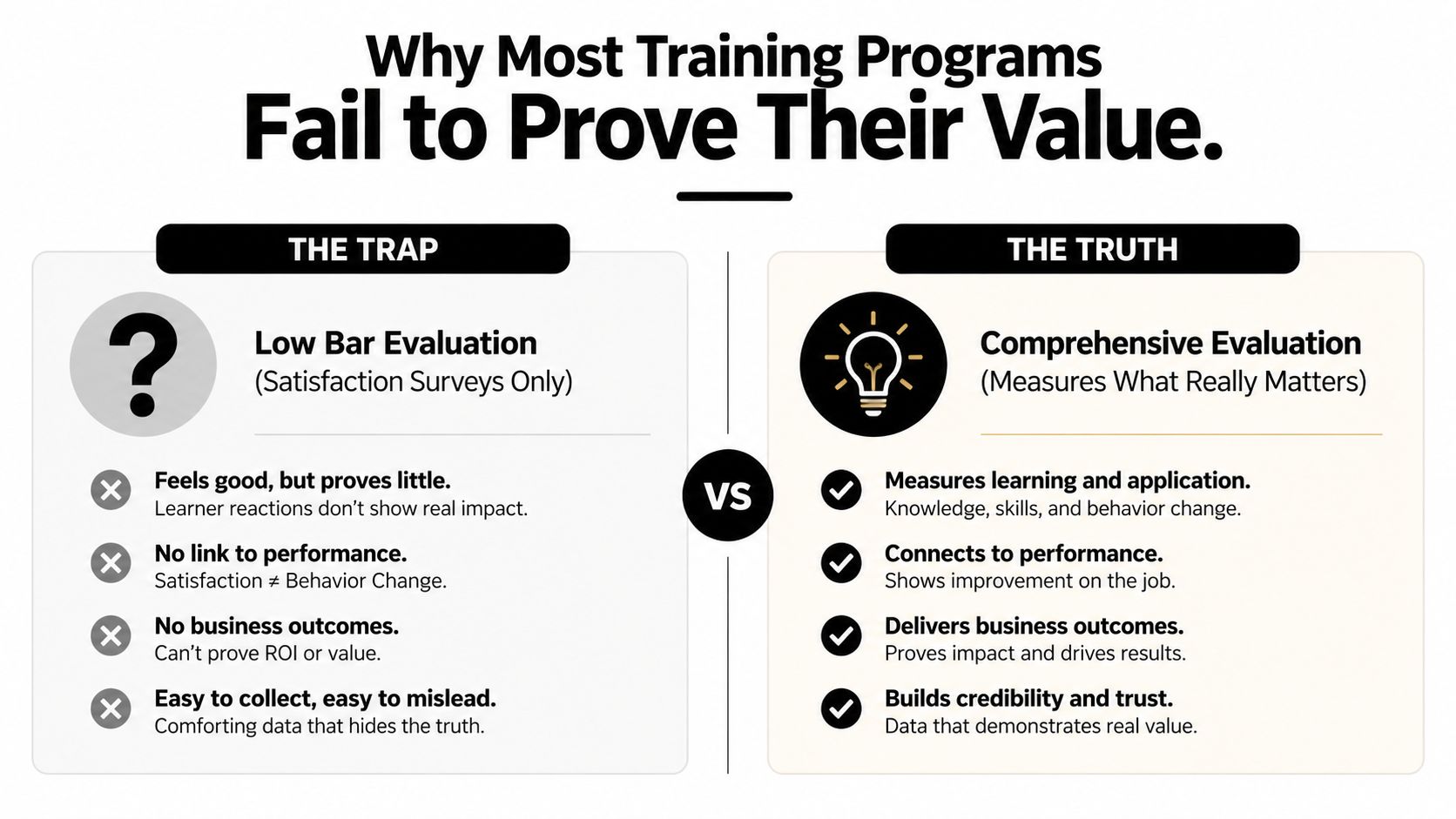
The lowest bar in training evaluation is also the most popular one. Participants complete a survey immediately after a workshop, rate the facilitator and content, and answer whether they'd recommend the session. L&D reports the results as evidence of effectiveness.
That approach measures reaction, not effectiveness. A participant can enjoy a polished presentation, appreciate the facilitator, and still fail to remember the material or apply it under pressure. A difficult program can produce useful behavior change while receiving mediocre immediate feedback because it challenged established habits or exposed uncomfortable performance gaps.
The distinction matters because satisfaction is an experience metric. Business value is an outcome metric. Confusing the two creates false confidence and makes it difficult for an executive team to decide which programs deserve more investment.
The survey trap
A post-session survey is useful when it's treated as a diagnostic instrument. It can reveal whether the content felt relevant, whether participants encountered delivery problems, and whether the audience understood the intended application. It becomes misleading when the survey is treated as the final verdict.
The common failure pattern looks like this:
- The program is popular: Participants praise the trainer and materials, so the program is declared successful.
- The quiz is passed: Learners recall concepts shortly after the session, so the organization assumes the skills will appear at work.
- The course is completed: The LMS records attendance and completion, so leaders receive an activity report instead of an impact report.
- The KPI moves: A business metric improves, so training receives credit without checking for other explanations.
Each signal has value, but none proves the complete chain from learning to results. Research on evaluating training effectiveness describes Kirkpatrick's model as a progression from reaction and learning to behavior and organizational results. That progression remains useful precisely because it prevents teams from stopping at the easiest evidence.
What leaders actually need to know
A credible evaluation answers four different questions:
- Did people participate and understand the material?
- Did they use the intended skills in their work?
- Did the behavior persist beyond the immediate follow-up?
- Did the change contribute to a business result?
The fourth question is where many programs become difficult to defend. Revenue, quality, retention, productivity, and compliance are affected by staffing, tooling, market conditions, leadership decisions, pricing, process design, and customer mix. Training may contribute without being the sole cause.
Practical rule: Never report a business outcome without showing the behavior that should have produced it.
A strong training effectiveness measurement system therefore doesn't discard surveys or quizzes. It puts them in their proper place. Immediate feedback helps improve the learning experience. Knowledge checks show whether learners acquired concepts. Neither should be mistaken for evidence that work performance changed.
The cost of weak measurement isn't just reputational. L&D teams waste time defending programs that aren't working, while effective programs fail to receive support because their impact wasn't tracked. The organization ends up optimizing for participation instead of performance.
Understanding the Kirkpatrick Model and Its Limits
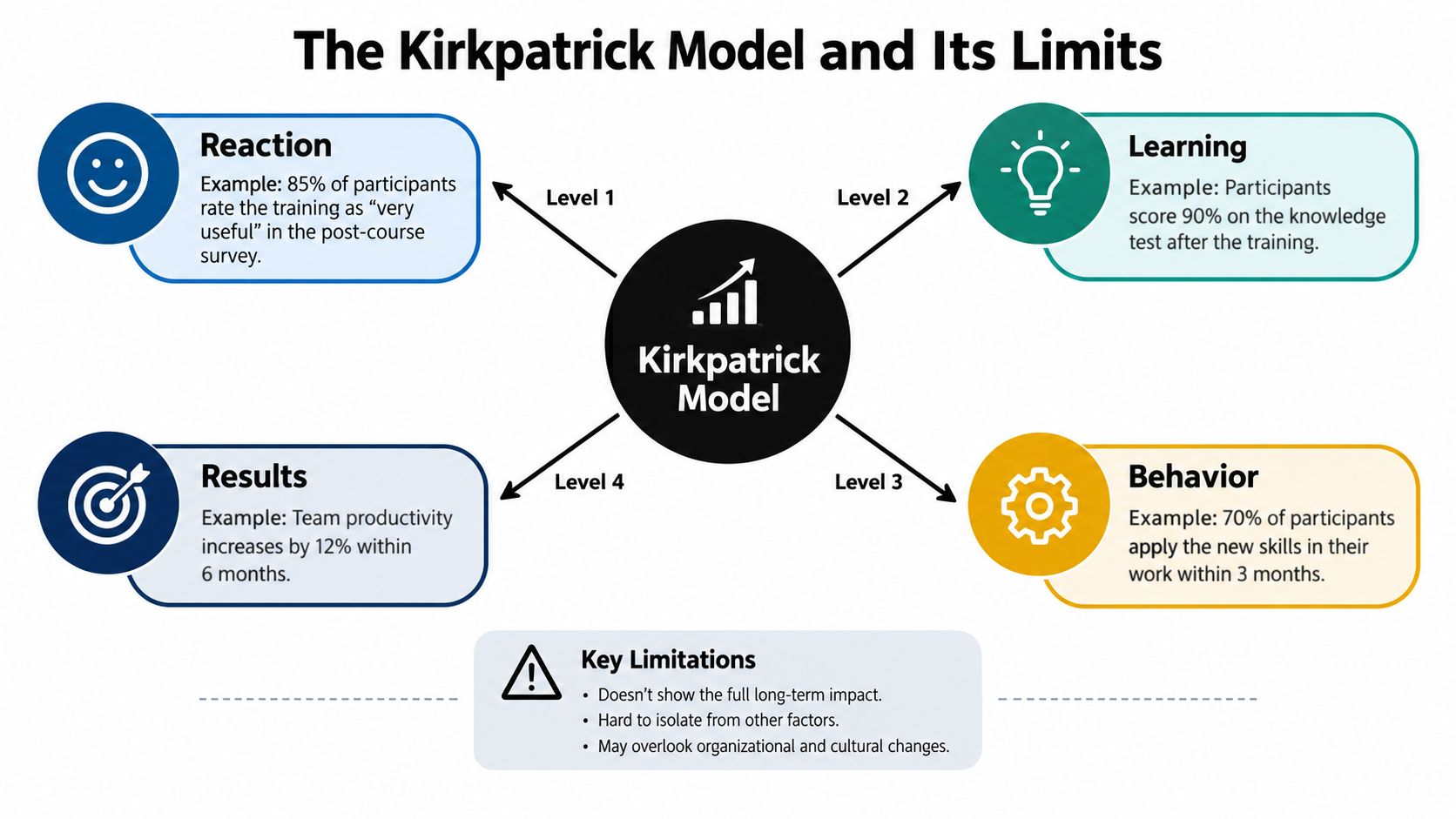
Donald L. Kirkpatrick's four-level model became a foundation for training evaluation after the 1994 publication of Evaluating Training Programs: The Four Levels. The book organized evaluation around reaction, learning, behavior, and results, while placing those measures within a broader 10-step training development process. Its practical contribution was straightforward: judge training by what it changes, not only by what participants say about it.
That principle still gives L&D and business leaders a shared language. The weakness appears in execution. Organizations can name all four levels, then measure only the first or second because later evidence requires baselines, manager involvement, agreed definitions, and access to operational data.
The four levels in operating terms
Level 1, reaction, records how participants experienced the training. Was the content relevant? Was the pace appropriate? Did the examples resemble the work? These answers help L&D improve design and delivery, but they do not show that performance changed.
Level 2, learning, tests whether participants acquired knowledge or capability. Knowledge checks, demonstrations, simulations, and scenario assessments provide stronger evidence than satisfaction scores. A correct answer in a controlled setting still does not prove that an employee will use the skill during a difficult customer conversation or a busy operational shift.
Level 3, behavior, examines application on the job. A manager might observe whether a sales representative uses a discovery framework, whether a supervisor holds structured coaching conversations, or whether a technician follows a revised safety practice. This level addresses training's proposed mechanism of impact, but it depends on clear behavioral definitions and repeated observation.
Level 4, results, connects changed behavior to an organizational outcome. Depending on the intervention, that outcome may involve productivity, quality, cost reduction, retention, compliance, customer experience, or another business priority. Select the result before delivery. Choosing it afterward because a metric improved makes the evaluation easier to sell and harder to trust.
Where the model breaks down
Kirkpatrick can look like a ladder, yet results do not automatically follow from behavior. An employee may use a new skill correctly and still miss the business target because the process is broken, the product is difficult to sell, or managers reward conflicting behavior. A business metric can also improve without any meaningful change in the trained behavior.
Kirkpatrick is therefore a measurement structure, not a causal proof system. It identifies what to inspect at different stages, but it does not separate training's contribution from every other change affecting the result. It also leaves the transfer problem to the operator: employees need manager support, usable tools, time, and reinforcement after the event.
Teams stall at Level 1 and Level 2 because survey and quiz data are cheap, immediate, and easy to aggregate. Levels 3 and 4 require managers, L&D, finance, operations, and business owners to agree on definitions, observation methods, and acceptable evidence. That coordination is slower, but it is where a defensible evaluation begins.
Use the model as a sequence of questions, not as proof that one level guarantees the next. The practical test is direct: What evidence would convince a skeptical operator that this intervention changed work and contributed to the result?
The Four Core KPIs That Matter for Business Outcomes
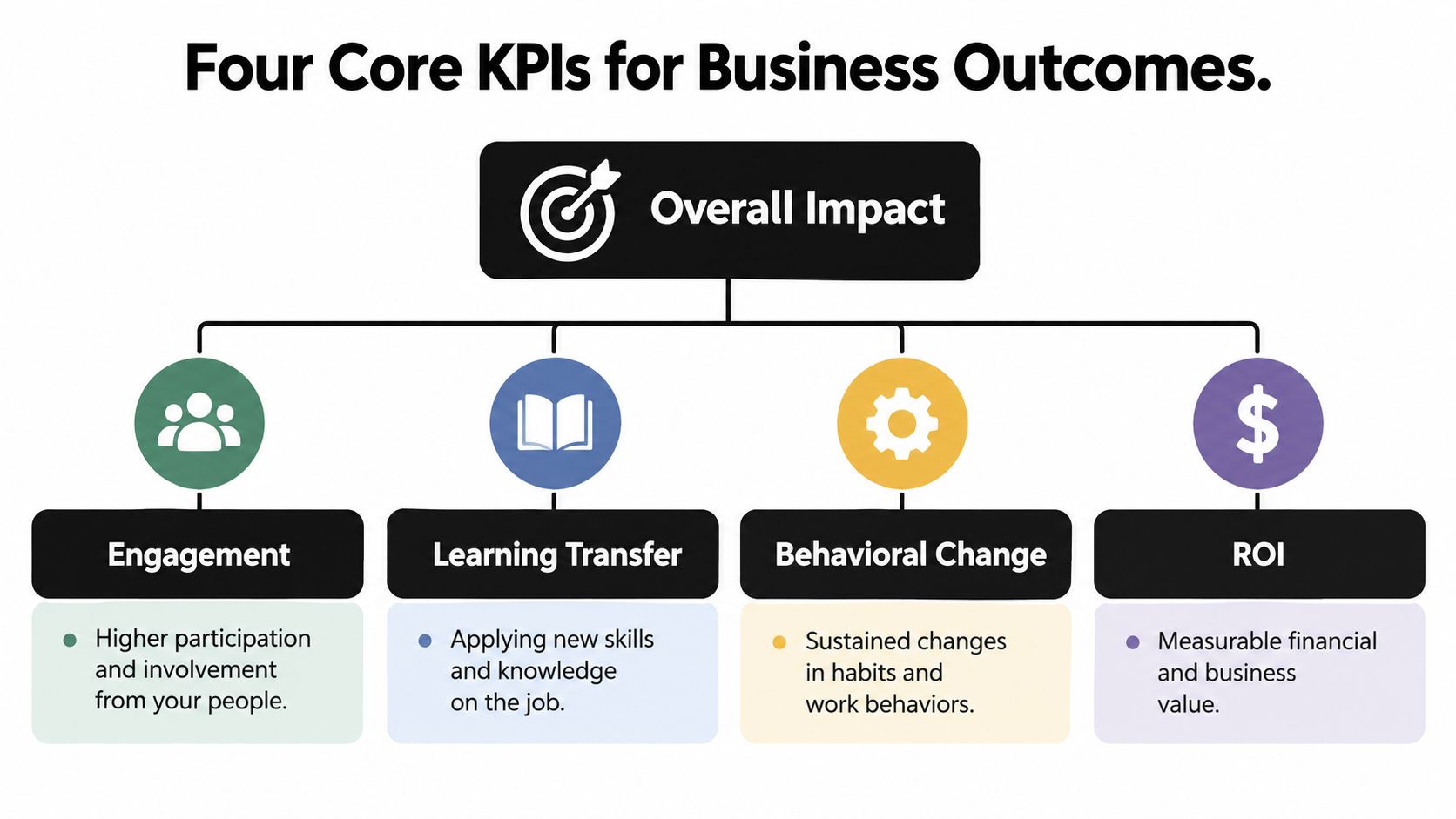
A useful scorecard separates activity from impact. Engagement tells you whether the program reached people. Learning transfer tells you whether participants used the capability. Behavioral change shows whether the new way of working became visible and sustained. Business outcomes show whether the change mattered to the organization.
These categories should connect, but they shouldn't be collapsed into one composite score. A high completion rate can coexist with weak application. Strong application can coexist with a flat business result. Those are different management problems and require different responses.
Define the measures before delivery
| KPI Category | What It Measures | How to Track |
|---|---|---|
| Engagement | Whether the intended audience participated and completed the experience | Attendance, completion records, participation patterns, and relevant reaction feedback |
| Learning transfer | Whether learners apply the capability in real work | Follow-up checks, work samples, manager observations, system activity, or scenario-based reviews |
| Behavioral change | Whether the target behavior becomes consistent and sustained | Repeated observation, quality reviews, coaching records, and operational performance indicators |
| Business outcomes | Whether the intervention contributed to an organizational priority | Predefined business KPIs, baseline comparisons, trend analysis, and contextual review with business owners |
Engagement is a reach metric. Track it because low participation can explain why a program didn't affect the target population. Don't use it as a proxy for value. A completed course is evidence that someone finished a course.
Learning transfer is where evaluation becomes operational. Define the observable action that should occur after training. For a manager program, that might be better goal-setting or more useful one-to-one conversations. For sales enablement, it might be consistent use of a qualification approach. The measurement should inspect work, not ask only whether the learner intends to apply the skill.
Behavioral change requires time. A single observation immediately after training can capture enthusiasm or compliance with the assessment. Repeated evidence shows whether the behavior survives competing priorities. Managers need a short, consistent rubric, and participants need a clear explanation of why the observation matters.
Business outcomes should reflect the original problem. If training addresses quality, track the relevant quality measure. If it addresses operational efficiency, use the operational measure. If it supports retention, define which population and business condition matter before the program begins. A dashboard built around generic learning activity won't answer an executive's question about value.
For a useful primer on connecting performance indicators to management decisions, review this guide to business intelligence KPI design. The same discipline applies here: define the decision, establish the measure, and make ownership explicit.
A visual dashboard can make the chain easier to inspect, but the reporting logic matters more than the chart type. The following video provides another perspective on the relationship between learning activity and organizational performance.
Report the four categories together, then diagnose the break in the chain. High engagement with low transfer points to design, relevance, incentives, or manager support. Strong transfer with no business movement points to attribution, operational constraints, or an outcome that training can't materially influence.
Estimating ROI and the Hidden Costs of Measurement
ROI measurement earns its place when leaders must compare a learning investment with other uses of money and management attention. A recent study indexed by IJRTI reported that organizations using ROI frameworks achieved an average 127% return on investment, with benefits averaging $2.27 for every $1 invested. The study also reported mean annual training expenditure of $1,847 per employee, with a standard deviation of $1,243, showing substantial variation in spending between organizations and industries.
The same study reported a mean ROI of 45% for managerial training compared with 418% for sales and technical training. Organizations should not apply one expected return to every category. Function, measurability, proximity to revenue or cost, and the operating environment all shape the result.
These figures are benchmarks, not promises. A published average cannot predict what a specific program will return. The answer depends on the problem selected, the quality of transfer support, the size of the affected population, the reliability of the baseline, and the share of the result that can reasonably be separated from other causes.
The economics of measurement
A serious ROI exercise creates costs of its own. Someone must define the business case, establish the baseline, connect learning records with operational data, validate assumptions with finance or operations, and follow up after employees return to work. The organization may also need reporting tools, data integration, analyst capacity, manager time, and governance for disputed numbers.
Measurement decisions should match the decision at stake. A small compliance module may need evidence of completion and retention rather than an elaborate financial model. A major sales, leadership, or transformation program deserves deeper analysis because the investment and potential consequences are larger.
For a broader view of the financial effort behind data collection and reporting, see this explanation of how much data costs. Measurement is not free. Weak measurement can cost more when it protects low-value work or conceals missed opportunities.
A credible calculation states the program cost, identifies the measurable benefit, documents how outcomes were converted into monetary value, and applies a conservative attribution estimate where direct causation cannot be demonstrated. Counting every favorable movement as a training benefit produces a persuasive spreadsheet, not a defensible business case.
Transfer support changes the observed return
Training events rarely carry the full burden of behavior change. Employees need opportunities to practice, manager reinforcement, job aids, feedback, and a reason to use the new capability. These are transfer activities. Design and measure them as part of the intervention rather than treating them as optional follow-up.
A synthesis of 32 studies comparing training alone with training plus learning-transfer activities reported that adding transfer support could improve learning effectiveness by over 180%, with performance outcomes rather than learning outcomes serving as the key measures, according to The Wilson Learning synthesis. The practical implication is clear: a training event without an application system may understate what the program can achieve.
| Training Type | Average ROI |
|---|---|
| Managerial training | 45% |
| Sales and technical training | 418% |
A practical calculator such as Spark's calcola ROI HR can help teams frame the financial conversation, but its output is only as good as the inputs. A defensible benefit figure names the affected population, specifies the baseline, identifies the measurement period, and states the attribution percentage the team is willing to claim. Use the calculator to expose assumptions and test scenarios, not to manufacture certainty.
Solving the Attribution Problem in Training Evaluation
The hardest question isn't whether a KPI improved. It's whether training caused any meaningful part of the improvement.
A sales team may increase conversion after training, but a new pricing package, stronger lead quality, a product release, or a change in territory allocation could have contributed. A support team may reduce escalations after a coaching program, but a workflow redesign or improved knowledge base may have done more of the work. A leadership program may coincide with stronger retention while compensation, hiring standards, and the labor market are also changing.
Attribution is widely identified as a major barrier to meaningful evaluation, and many organizations still don't consistently measure on-the-job behavior or business outcomes. Industry commentary on the difficulty of proving training impact reflects the operational reality: teams can name the desired outcomes, but they often lack a credible comparison or a clean chain of evidence.
Separate the intervention from the noise
Start with a causal story that can be tested. Define the business result, the behavior expected to influence it, and the other changes that could affect the same result. Then choose measures in order of attribution strength.
A behavior close to the intervention is often easier to interpret than a distant business result. For example, a sales training program might first measure whether representatives use the qualification questions and whether call reviews show improved discovery behavior. Conversion can then serve as an outcome measure, while total revenue receives more cautious interpretation because it is exposed to more external variables.
Useful designs include:
- Baseline comparison: Establish the pre-training level using a consistent definition before the intervention begins.
- Comparison groups: Where practical, compare trained and untrained teams, phased rollouts, or locations with similar operating conditions.
- Timing checks: Examine whether the behavior changed after training and whether the business result followed it, rather than treating any simultaneous movement as proof.
- Context review: Record tooling changes, process revisions, leadership initiatives, staffing changes, and market events that could explain the result.
- Manager evidence: Use structured observations and work samples to confirm that the intended behavior did in fact occur.
No design eliminates uncertainty in every workplace. It does make the conclusion more honest. For teams that need a deeper conceptual treatment of how to find true cause and effect, causal inference provides useful language for separating correlation from contribution.
Measure transfer after the event
Immediate post-training testing captures an early state. It doesn't show whether an employee can use the capability under normal workload, whether a manager reinforces it, or whether the behavior survives competing priorities. The transfer gap between learning and performance remains a persistent problem, particularly between knowledge acquisition and workplace application. This discussion of training evaluation and the Level 2-to-3 gap highlights why completion and quiz data are insufficient.
One evaluated program reported skill usage over 100% higher and performance impact 48% higher when transfer activities were added, with performance measured three months after completion. The Wilson Learning program benchmark demonstrates why delayed, on-the-job measurement can produce a materially different view of effectiveness.
The trade-off is effort. Delayed measurement creates follow-up work, lower response rates, and greater dependence on managers and operational systems. It is still the better choice when the organization needs to know whether training changed performance rather than whether participants remembered the session.
For teams testing a rollout or comparing intervention groups, incrementality testing offers a useful way to think about the additional outcome created by the intervention. The key is to report contribution accurately. “Training contributed to the improvement” is often more credible than “training caused the improvement.”
Building Your Training Measurement System
Build the measurement system backward from a business decision. Start by identifying the result leaders care about, then define the behavior that should influence it, the learning required to support that behavior, and the participation signals needed to diagnose reach. If a KPI can't influence a decision, it probably doesn't belong on the main dashboard.
Use a small scorecard with clear ownership:
- Business owner: Confirms the problem, target outcome, baseline, and competing initiatives.
- L&D owner: Defines the learning intervention, transfer activities, and learning evidence.
- People managers: Validate whether behavior appears in real work.
- Finance or operations: Review monetary assumptions and outcome definitions.
- Data owner: Maintains consistent reporting and explains limitations.
Choose measurement depth according to risk and investment. A simple program can use reaction, learning, and a focused follow-up measure. A strategic initiative needs behavior tracking, a comparison approach where feasible, transfer support, and a documented attribution judgment.
The in-house versus external decision depends on repeatability and internal capacity. Hire data staff when measurement is a recurring strategic capability with enough volume, stable ownership, and leadership support to sustain it. Use an external service when the immediate need is trustworthy reporting, the company lacks a data team, or leaders need answers before a full hire would be productive. The same logic applies when assessing programs such as AI upskilling for growth-stage leaders, where adoption and operational behavior matter more than attendance alone.
Keep the dashboard focused on the questions executives ask: Did people use the skill? Did performance change? What else changed? How confident are we in the attribution? What should we continue, redesign, or stop?
HelpWithMetrics connects fragmented business data into trustworthy dashboards and AI-answerable metrics, so training leaders can see whether learning changed behavior and contributed to results. Visit HelpWithMetrics to book a call and get a free first dashboard that makes the evidence easier to act on.